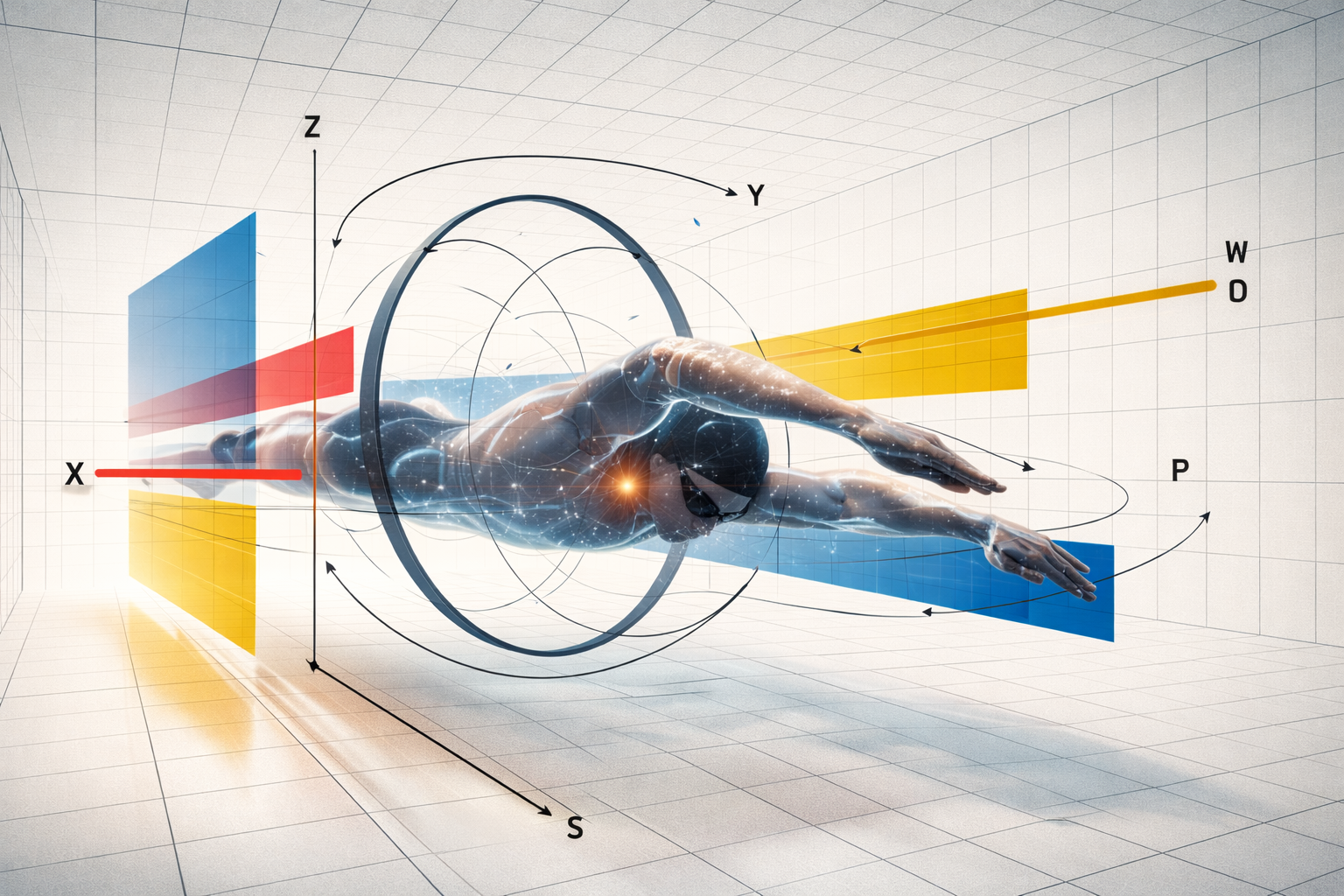
How immersive video modeling can sharpen technique and inspire a modern training loop
Virtual reality supported video modeling is a training method where you put on a headset, watch an expert skill in a three dimensional first person video, then practice that same skill in real life. 1 It is rehearsal for your nervous system before you touch the water. In a randomized trial with adult beginner swimmers, researchers paired this approach with standard lessons and tracked technique and effort in ways coaches care about.
If you have ever felt the gap between what a coach says and what your body does, this paper lands like a flashlight. It also hints at a bigger idea that matters beyond swimming. Skill is not only built by grinding. Skill is built by seeing, sensing, and repeating the right picture until it becomes automatic. That is where immersive swim training and good coaching design start to overlap.
The Wake Up Lap
Performance gets real when technique becomes measurable
Most beginners do not lose time because they lack grit. They lose time because their stroke is expensive. It costs extra effort to move forward, and that effort shows up as rushed breathing, sloppy timing, and a body position that fights the water. The study you are about to explore was built around a simple performance question. Can an immersive technique preview help a new swimmer move better in the pool, not just feel better about trying.
Researchers worked with university students who were true non swimmers at the start. Both groups received the same traditional instruction, one session per week over an academic term. The difference was what happened before they got in the water. One group watched entertaining sports videos on a tablet as a time matched warmup. The other group did virtual reality assisted coaching for roughly half an hour, watching five first person training videos inside an HTC Vive Pro headset created from custom filming and editing. 1
- The immersive group watched and mentally rehearsed key drills such as breathing with kicking, kickboard work, strokes with a kickboard, floating, and full crawl practice. 1
- After the training period, performance was judged with video analysis by expert raters who counted strokes and kicks and timed a full length swim while also recording heart rate and perceived effort. 1
- The immersive group finished with fewer strokes per length, more kicks, faster swim time, and lower perceived effort, while heart rate did not clearly separate the groups. 1
That pattern is the whole story of performance in miniature. Fewer strokes can signal a cleaner line and better propulsion. More kicks, in early stage swimmers, can support balance and forward drive when the arms and breath are still learning to cooperate. Faster time is the outcome everyone sees. Lower perceived effort is the clue that the movement is getting cheaper. Together, these are not random wins. They suggest motor skill acquisition improved, not just motivation to try harder. 1
What makes this paper feel different is the craft of the intervention. It was not generic virtual reality gaming. It was immersive video modeling, built to match a pool reality with first person perspective. In plain language, the swimmer did not just watch a demo. The swimmer stepped into the demo. That detail matters because the brain often learns a skill by building a clear internal movie, then refining it through repetition.
The Deep Dive
Four research grounded reasons this works and where the science warns you
A clearer movement map
Video modeling sits on a sturdy foundation called observational learning. When you watch a skilled model, you are not copying like a parrot. You are building a blueprint your body can call back when it is time to move. A systematic review in physical education settings found observational learning can improve motor skill learning, and it also notes that details like model type and verbal cues can change the size of the effect. 4 The swimming trial adds a practical extension. It shows that when the model is immersive and first person, beginners can translate that blueprint into better pool performance measures. 1
Less mental overload in the hardest stage
Early learning is messy. You are trying to breathe, float, kick, and coordinate arms while listening to instructions you barely understand yet. This is where cognitive load can crush progress. Research on learning motor skills from video formats uses cognitive load theory to explain why well designed visual information can reduce working memory strain and support learning compared with less supportive formats. 6 The swimming trial matches that logic in a sport setting. The virtual reality group likely arrived in the water with a cleaner picture of what to do, so pool time could be spent practicing instead of guessing. 1
Confidence in the water before you get wet
Swimming has a unique barrier that many sports do not. Water adds fear, uncertainty, and a feeling of losing control. This study excluded people with strong water phobia, yet it still highlights a psychological angle. The immersive group reported lower perceived effort after training. 1 In broader research, virtual reality experiences are often linked with changes in anxiety responses, and a meta analysis in virtual reality exposure therapy found presence and anxiety are related in measurable ways. 7 In a hydrotherapy context for children with burns, a randomized crossover trial reported virtual reality distraction reduced pain during stressful sessions, and studies like this are part of why researchers consider VR a tool for calming high stress situations. 8 The key takeaway for training is simple. When stress drops, attention can go back to technique.
Transfer depends on design, not hype
Virtual reality is not magic. The hardest question is transfer. Does practice in a headset help you move better in the real world. A Frontiers systematic review on virtual environments in sport found early evidence for real world improvement is encouraging, but the number of transfer focused studies is still small. It also warns that mismatches between the virtual task and the real task can lead to negative effects in technique. 2 A PLOS ONE experiment using an off the shelf immersive VR system for golf putting found VR practice improved real world performance similarly to physical practice in that specific task, while also noting that other studies have shown mixed or negative transfer when similarity is low. 3
This is why the swimming paper matters. It did not train a totally different movement. It trained first person technique viewing that closely matched the pool setting, then immediately paired it with real pool practice. That pairing is a strong example of extended reality training used as a bridge, not a replacement. If you want a real skill transfer payoff, design the virtual content to match the movement, the timing, and the cues you use in the water. 1 5
Personal Blueprint
Why tailoring matters and how conversational coaching turns watching into doing
The study used the same set of immersive videos for everyone, which is perfect for research. Real life is different. You have a dominant breath side. You have a kick rhythm that either stabilizes you or throws you off. You have a fear profile, a learning style, and a schedule. Personalization is not a luxury, it is how you protect consistency.
Here is a simple way to make the method yours without inventing new science. Keep the core loop the paper tested. Watch, mentally rehearse, then swim the same ideas. Now add a feedback layer that helps you choose one cue at a time and stay honest about what you felt. If you want a place to store short clips and comparisons, start by build your personal stroke library. If you want to keep habits consistent across weeks, use track your weekly training rhythm so your immersive rehearsal and pool time stay connected.
To make this more engaging, use conversational AI prompts that act like a calm coach. The goal is not more information. The goal is better questions and cleaner cues.
Act as my swim coach and motor learning guide. Ask me a few questions about my current freestyle, breathing comfort, and kick rhythm. Then give me one cue to focus on during a short virtual reality technique preview and one cue to focus on during my next pool session. Keep it simple and measurable.
I am using immersive video modeling to learn swimming. Help me create a short pre swim rehearsal script I can read out loud before I watch the video. It should include breathing, body line, and one technical image. Make it sound like a confident inner voice, not a lecture.
Here are my notes from today’s swim and how hard it felt. Turn this into a tiny feedback loop. Identify what likely improved, what likely drifted, and one adjustment for next time. Then write a one sentence reminder I can pin in my training log.
Design a beginner friendly plan that mixes virtual reality swim training with real pool practice. Keep the plan focused on technique, not fitness. Include a short warmup, a main set that repeats one skill theme, and a cool down reflection question.
Notice what these prompts do. They keep the technology pointed at behavior. They also nudge you toward a clean motor learning loop where the same cue shows up in your eyes, your imagination, and your stroke.
The Long Loop
Keeping performance and lifestyle in the same rhythm through art, science, technology, and design
The most useful part of this research is not the headset. It is the idea that learning can be engineered. You can shape attention, reduce noise, and repeat a clean image until it sticks. That is design thinking applied to performance.
Here are sustainable takeaways that keep the training loop alive without burning you out. They blend the art of movement with the science of repetition and the technology of feedback.
- Create a studio minute before you swim. Pick a calm soundtrack, watch a short technique clip, then close your eyes and imagine the stroke as choreography. You are training perception and timing, not only muscles.
- Choose one cue per session and keep it consistent across the day. If the cue is long body line, then your warmup, your main set, and your cool down reflection all orbit that one idea. This reduces cognitive overload and increases skill transfer.
- End with a tiny design review. Write two sentences in your notes. What felt easier and what felt unstable. Over weeks, this becomes your personal dataset, and it makes your next rehearsal smarter.
The paper also gives you permission to think bigger than swim drills. When you treat technique as a creative project, you stop chasing random tips. You start building a repeatable system. That is how performance and lifestyle can meet without conflict.
FAQ
Is this only useful for beginners
The strongest evidence in this paper is for new swimmers learning foundational skills. More advanced athletes may still benefit from immersive technique previews, but transfer tends to depend on how closely the virtual viewing matches the exact skill you want to change. 2
Do I need a long virtual reality session for this to work
In the study, the immersive group trained for about half an hour before each pool session, then practiced in the water right away. The bigger principle is not duration. It is consistency and pairing. Watch, rehearse, then do the movement soon after. 1
References
1 Namli S, Özdemir K, Sen I, Bedir D. Virtual reality supported video modeling for enhancing motor skill acquisition in swimming. BMC Sports Science, Medicine and Rehabilitation. Two thousand twenty five.
2 Michalski S C, Szpak A, Loetscher T. Using virtual environments to improve real world motor skills in sports, a systematic review. Frontiers in Psychology. Two thousand nineteen.
3 Markwell L T, Cochran K, Porter J M. Off the shelf, investigating transfer of learning using commercially available virtual reality equipment. PLOS ONE. Two thousand twenty three.
4 Han Y, et al. Use of observational learning to promote motor skill learning in physical education, a systematic review. International Journal of Environmental Research and Public Health. Two thousand twenty two.
5 Levac D E, Huber M E, Sternad D. Learning and transfer of complex motor skills in virtual reality, a perspective review. Journal of NeuroEngineering and Rehabilitation. Two thousand nineteen.
6 H’mida C, et al. Learning a motor skill from video and static pictures with a cognitive load lens. Frontiers in Psychology. Two thousand twenty.
7 Ling Y, Nefs H T, Morina N, Heynderickx I, Brinkman W P. Meta analysis on the relationship between self reported presence and anxiety in virtual reality exposure therapy. PLOS ONE. Two thousand fourteen.
8 Khadra C, et al. Effects of a projector based hybrid virtual reality on pain in young children with burn injuries during hydrotherapy sessions, a randomized crossover trial. Burns. Two thousand twenty.
Leave a Reply
You must be logged in to post a comment.